
Theory Testing from a Critical Realist Perspective
In a previous post, it was demonstrated that researchers can play two different roles, as they can either build or test theories. An SMJ article by Miller and Tsang (2011), which is titled Testing management theories: Critical realist philosophy and research methods, focuses on the latter role we can play. The authors claim: “Not only do we have a plurality of theories within management research, there is also no consensus about the criteria for evaluating theories.” Taking a critical realist perspective, they advance practical guidance for evaluating management theories by proposing a four-step approach to theory testing. This approach includes (1) identifying the hypothesized mechanisms, (2) testing for the presence of the mechanisms in the empirical setting, (3) testing isolated causal relations, and (4) testing the theoretical system. The authors underline that “steps 2 and 3 have been neglected for the most part”. In sum, a lot can be learnt about theory testing from this brilliant article.
Miller, K., & Tsang, E. (2011). Testing management theories: Critical realist philosophy and research methods. Strategic Management Journal, 32 (2), 139-158 DOI: 10.1002/smj.868
Egocentric Network vs. Whole Network Level of Analysis
Supply chains have often been regarded as interorganizational networks. An incredibly insightful article by Provan et al. (2007), Interorganizational networks at the network level: A review of the empirical literature on whole networks, makes clear that two different views on interorganizational networks need to be distinguished: (1) the view from the organizational level of analysis (also referred to as actor level, micro-level or egocentric network level) and (2) the view from the network level of analysis (also referred to as macro-level or whole network level). Egocentric theories often focus on the “embeddedness” of an organization in a network and on dyadic relationships. The authors argue that “[o]nly by examining the whole network can we understand such issues as how networks evolve, how they are governed, and, ultimately, how collective outcomes might be generated”. Their article provides a review of studies of whole networks. I am certain that supply chain management research can benefit from this valuable contribution.
Provan, K., Fish, A., & Sydow, J. (2007). Interorganizational Networks at the Network Level: A Review of the Empirical Literature on Whole Networks. Journal of Management, 33 (3), 479-516 DOI: 10.1177/0149206307302554
Natural Resource Scarcity
In their recently published JBL paper, A natural resource scarcity typology: Theoretical foundations and strategic implications for supply chain management, Bell et al. (2012) rightly note: “Scarcity of critical natural resources such as oil, water, food, and precious metals has the potential to greatly impact commercial activity as the twenty-first century progresses”. In deed, avoiding waste of resources has become a top priority for many supply chain practitioners. However, in view of the importance of the topic, it is baffling that supply chain management research has almost completely neglected resource scarcity. Our theories are concerned with resources (e.g., resource-based theory, resource-dependence theory), but resource scarcity does not really play a big role. Therefore, the article by Bell et al. is certainly a step in the right direction. The authors position natural resource scarcity as a supply chain risk factor, and prescribe strategies for its mitigation. Particularly, they offer a natural resource scarcity typology.
John E. Bell, Chad W. Autry, Diane A. Mollenkopf, & LaDonna M. Thornton (2012). A natural resource scarcity typology: Theoretical foundations and strategic implications for supply chain management Journal of Business Logistics, 33 (2), 158-166 DOI: 10.1111/j.0000-0000.2012.01048.x
Cloud Logistics
Usually, I hate buzzwords. Particularly, I am saturated by the extensive use of the phrase “cloud computing”. However, a keynote speech by Werner Delfmann about “cloud logistics”, which was held at the 6th International Scientific Symposium on Logistics in Hamburg, Germany, exceeded all my expectations. Delfmann’s speech is based on discussions within the BVL‘s Scientific Advisory Board and the discussion paper The Cloud – Logistics for the Future? by Delfmann and Jaekel (2012) can be downloaded on the BVL’s website. Herein, the authors transfer the cloud paradigm from computing to logistics. They argue that an “adequate answer to the challenges for logistics arising from an increasingly complex, uncertain, volatile and less predictable environment seems to be found in principle by means of adaptive, coordinated, distributed, autonomous logistics systems based on decentralized self-control mechanisms”. I believe that cloud logistics can influence our notion of logistics service providers: They might move into a “cloud operator” role.
Theory Building and Theory Testing
Research revolves around theory. Hereby, the role of researchers is twofold: Researchers can either start with real-life observations and produce a set of propositions that summarize a new theory (inductive theory building), e.g., using grounded theory research, or start with an existing theory for formulating hypotheses and use data to test them (deductive theory testing), e.g., using structural equation modeling.
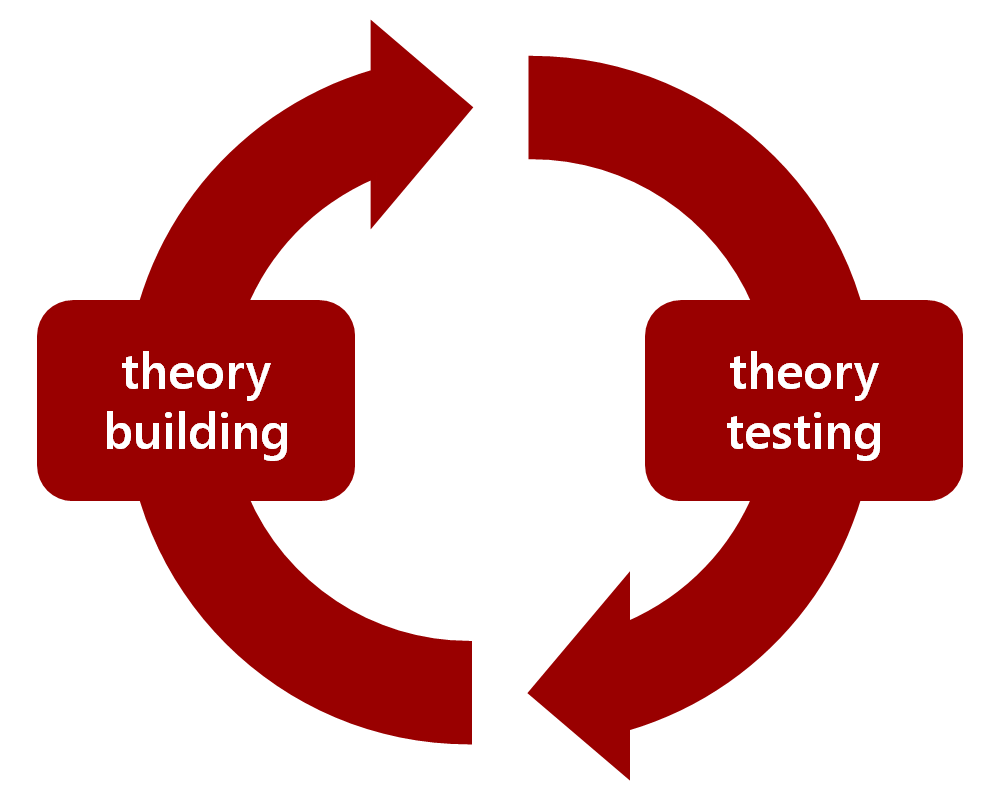
For an extensive investigation of this dual role see Colquitt and Zapata-Phelan (2007).
Colquitt, J. & Zapata-Phelan, C. (2007). Trends in theory building and theory testing: A five-decade study of the Adademy of Management Journal. Academy of Management Journal, 50 (6), 1281-1303 DOI: 10.5465/AMJ.2007.28165855
Resource-based Theory vs. Supply Chain Management
There is an ongoing debate in supply chain management research about whether or not resource-based theory suggests that supply chain management can be a source of sustained competitive advantage for a firm. Among those who have denied this suggestion is Ramsay (2001), whereas, in his recent essay, Barney (2012) has argued that SCM can, “at least in some settings”, be such a source. In his insightful article, The competitive advantage of interconnected firms: An extension of the resource-based view (AMR, Vol. 31, No. 3), Lavie (2006) follows the relational view, an extension of the resource-based view to networked environments (read my previous text about the relational view). He integrates and extends this view and social network theories, “contrasting the formulation of the traditional [resource-based view] with a reformulated version of the [resource-based view] that takes into account the impact of network resources”. Given the ongoing debate in our field, should SCM researchers adopt Lavie’s reformulation?
Lavie, D. (2006). The competitive advantage of interconnected firms: An extension of the resource-based view. Academy of Management Review, 31 (3), 638-658 https://doi.org/10.5465/AMR.2006.21318922
Supply Chain Management Definition
SCM definitions are a dime a dozen. An early definition comes from Cooper et al. (1997): “Supply chain management is the integration of business processes from end user through original suppliers that provides products, services and information that add value for customers.” However, this definition assumes that integration – the Emperor’s new suit? – is always good and that the unit of analysis is a customer-focused rather than a closed-loop system. Mentzer et al. (2001) argue that SCM has “the purposes of improving the long-term performance of the individual companies and the supply chain as a whole”. Here, it should be stated more explicitly that performance means “triple bottom line” performance. The CSCMP’s definition of SCM acknowledges that SCM is focused on interacting business entities. But, this definition violates some of Wacker’s (2004) eight rules for a “good” formal conceptual definition. Future SCM definitions should be focused on the coordination of business entities in closed-loop supply and demand networks.
Social Science Research: Principles, Methods, and Practices
I like open access. The USF Tampa Library hosts a collection of open access textbooks. One of them, which might be useful for many SCM researchers, has been published by Anol Bhattacherjee, a professor of information systems. It is titled Social Science Research: Principles, Methods, and Practices. The book, which is succinct and compact, is about the entire research process and it is designed “to introduce doctoral and graduate students to the process of scientific research”. The initial chapters 1 to 4 give an introduction to research. This includes topics such as “thinking like a researcher” and “theories in scientific research”. The chapters 5 to 8 are about the basics of empirical research (i.e, research design, construct measurement, scale reliability/validity, and sampling). The chapters 9 to 12 are concerned with data collection (i.e., survey research, experimental research, case research, and interpretive research). Both qualitative and quantitative data analysis is explained in the chapters 13 to 15. The last chapter is about research ethics.
The Science of Operations and Supply Chain Management
The Journal of Operations Management has now published two interesting articles about the science of operations and supply chain management. These two articles are intertwined and they were written by Singhal and Singhal (2012). The first article is titled Imperatives of the science of operations and supply-chain management and discusses two opportunities for pursuing radical innovations. The first opportunity is the pursuit of all phases of science (including theory development and theory testing). The second opportunity is the pursuit of multiple perspectives (e.g., based on different methods and different parts of a system). The second article is titled Opportunities for developing the science of operations and supply-chain management and proposes and analyzes ways to seize these two opportunities. It is found that networks of research teams, outliers, and meta-analyses can help to obtain multiple perspectives and to discover radical innovation. In conclusion, both articles will help our community to further develop SCM research.
The Network Inertia Perspective
In their insightful AMR article, Framing interorganizational network change: A network inertia perspective, Kim et al. (2006) argue that it is often unlikely that firms will replace their network partners based solely on economic motivations. The authors use the term “network inertia” for these constraints on network change and define it as “a persistent organizational resistance to changing interorganizational dyadic ties or difficulties that an organization faces when it attempts to dissolve old relationships and form new network ties”. In their theoretical framework, Kim et al. describe causal mechanisms for the action of constraints on network change and formulate twelve propositions. For instance, the likelihood of an organization to change its network ties is higher if its environment is competitive or its status is high, but this likelihood is lower if the organization is large or old. The framework can be applied to different units of analysis, particularly to supply and demand networks.
Kim, Tai-Young, Oh, Hongseok, & Swaminathan, Anand (2006). Framing interorganizational network change: A network inertia perspective. Academy of Management Review, 31 (3), 704-720 DOI: 10.5465/AMR.2006.21318926
