
Supply Chain Management: A Content Analysis
I just read an article by Vallet-Bellmunt et al. (2011): Supply Chain Management: A Multidisciplinary Content Analysis of Vertical Relations between Companies, 1997–2006. It gives a good overview of SCM research published in journals related to marketing, logistics, management, and marketing channels. The authors find that the work type of most research is empirical in nature, primary information is used more often than secondary information, the information type is mostly quantitative in nature, studies are mainly explanatory-predictive, the period of time in which the research is carried out is mostly cross-sectional, the geographical area is mainly national, and manufacturing samples are used most often. Particularly, the article confirms my suspicion that there is “shortage of studies conducted on the supply chain as a network of enterprises“. Instead, most research turns out to focus on a single enterprise or on the relationships of a single enterprise with its suppliers or customers.
Transaction Cost Economics vs. Supply Chain Management
When Oliver E. Williamson published his article Outsourcing: Transaction cost economics and supply chain management (2008), he confronted SCM research with uncomfortable questions. Surprisingly, it took four years until the first SCM researcher, Paul Zipkin, published A Reply to Williamson’s “Outsourcing …” (Production and Operations Management, Vol. 21, No. 3). Some of them may be provoking, but we should not brush aside the questions raised by Williamson. For example, he states that the “unit of analysis for TCE is the transaction” and asks: “The corresponding unit of analysis for SCM is what?” Zipkin rightly states: “We may be eclectic, but no one can accuse us of being parochial”. But this should be no excuse for us to ignore that our unit of analysis is the supply and demand network. Williamson reminds us that SCM research needs its paradigm. We need a consistent theory of the supply chain rather than eclectically adjusting theories that actually describe other units of analysis.
Interorganizational Relationships
I wish to call attention to an article by Parmigiani and Rivera-Santos, which was recently published in the Journal of Management: Clearing a path through the forest: A meta-review of interorganizational relationships. The authors conduct a review of reviews (meta-review) that were concerned with forms (i.e., alliances, joint ventures, buyer–supplier agreements, licensing, co-branding, franchising, cross-sector partnerships, and networks) and theories (i.e., organizational economics and organization theory) of interorganizational relationships. The authors also propose that any interorganizational relationship combines “traits from two hypothetical, pure relationship forms”: co-exploration and co-exploitation. The former aims to “create new knowledge, tasks, functions, or activities”, whereas the latter aims to “execute existing knowledge, tasks, functions, or activities”. This framework really clears a path through the forest, in which specific theories or forms are the “trees” and the overall nature of these relationships is the “forest”. I believe that this path is interesting for many researchers in our field.
The Relational View in SCM Research
Published in 1998, The relational view: Cooperative strategy and sources of interorganizational competitive advantage by Dyer and Singh remains one of the most influential business papers. Ten years later, the authors discussed their paper in an interview with ScienceWatch.com. They argue that “the main contribution of the [paper] was that it outlined a theory for considering dyads and networks of firms as a key unit of analysis for explaining superior individual firm performance”. The relational view extends both the industry structure view (unit of analysis: industry) and the resource-based view (unit of analysis: firm), because from this view a critical resource can span firm boundaries. The four sources of interorganizational competitive advantage identified by the authors are: (1) relation-specific assets, (2) knowledge-sharing routines, (3) complementary resources/capabilities, and (4) effective governance. While researchers are still searching for the paradigm of SCM research, the relational view can be an important building block to explain the supply and demand network. The relational view has later been extended by Lavie (2006).
Supply and Demand Network Management
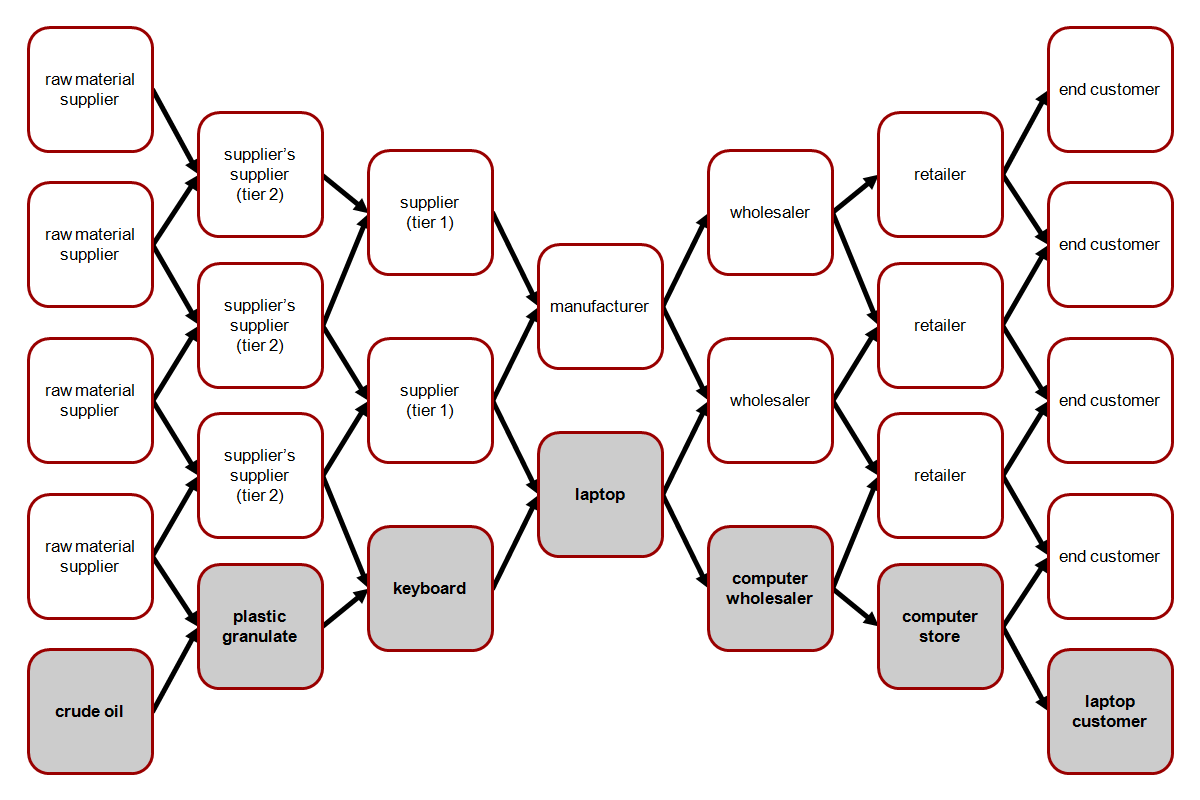 “Supply chain” is not the right word. The system it describes is not restricted to the supply side and it does not take the form of a chain. Should it be “supply and demand network management” rather than SCM?
Supply Chains as Complex Adaptive Systems
As recently discussed on this website, the paradigm of SCM research should refer to the system “supply chain” rather than to the system “company” or to the system “supplier-buyer relationship”. In their interesting conceptual note, Supply Networks and Complex Adaptive Systems: Control versus Emergence, Choi et al. (2001) acknowledge the notion of a supply network as a system. The authors go even further and argue that supply networks should be recognized as a complex adaptive system (CAS). Choi et al. propose that many supply networks emerge rather than result from purposeful design by a singular entity. They also emphasize that when managing supply networks, managers must appropriately balance how much to control and how much to let emerge. A similar viewpoint has later been taken by Surana et al. (2005; Supply-chain Networks: A Complex Adaptive Systems Perspective). Can the notion of a supply chain as a complex adaptive system be a building block for the missing paradigm of our discipline?
Why Theory is Relevant to Supply Chain Research
The Journal of Business Logistics has changed (I recently reported). In their first editorial, the new editors, Stanley E. Fawcett and Matthew A. Waller, share their vision and expectation that “articles published in the Journal of Business Logistics will be grounded in sound theory and make a clear contribution to theory development”. The authors help us to “make sense out of chaos” by clarifying a number of questions: What is theory and should research conversations describe, explain and/or prescribe? What constitutes a valuable theoretical contribution? The authors emphasize that good research must be both influential and interesting and they suggest a three-step action plan to assure that we produce and deliver good theory. The JBL’s editoral is already the second valuable essay about theory development published by an SCM journal within a very short time, the other one being a discussion about conceptual theory development in the Journal of Supply Chain Management. Theory development matters!
Searching for the Paradigm of SCM Research
Before Thomas S. Kuhn published The Structure of Scientific Revolutions, it was accepted that science develops in a gradual chain of new truths that build on existing truths. Scientific progress, as mentioned by Karl Popper, can then be achieved just by consequently applying the scientific method. However, Kuhn’s book proved to be as revolutionary as its title may suggest. Besides “normal” phases of a science, in which the scientific method will be applied, there are also “revolutionary” phases. For example, researchers applied the scientific method within Newton’s paradigm, but Einstein’s revolution abruptly created a new paradigm. In addition, Kuhn describes sciences that are still searching for their paradigm (i.e., “pre-paradigm” phase). A broad range of different theories are used in SCM research, e.g., transaction cost theory and resource-based view. But these theories refer to the system “transaction” or the system “resource” rather than to our system, the “supply chain”. This indicates that our discipline has not yet found its paradigm.
Building Theory in the SCM Field
The Journal of Supply Chain Management has published an interesting forum that discusses the conceptual theory development approach within the context of our discipline. In his introducing essay, the co-editor-in-chief Craig C. Carter describes the JSCM’s perspective/philosophy towards conceptual theory development and introduces guidelines for both authors and reviewers. Choi and Wacker examine selected papers over a time period of the last 10 years to reveal good theory-building practices. Ketchen and Hult observe that powerful tools for guiding the theory building process have been developed within the organizational sciences, but have not yet found widespread application within our field. They describe several of these tools and explain how they can be used to enhance theory building within SCM. In her article, Rindova emphasizes the process through which ideas develop into a value-added theoretical contribution. Finally, Skilton’s essay discusses the process of developing theory during the review process for conceptual articles in contrast to empirical articles.
